Construction Draw Schedules: How Builders Get Paid Through a Build
A construction draw schedule ties each payment to a completed stage of work rather than a calendar date. Here is how the milestones are set, who verifies them, and the mistakes that leave builders financing someone else's house.

Ressio Staff
October 9, 2026
A construction draw schedule is the agreed timetable that sets when a builder gets paid during a project, tying each payment to a defined stage of completed work rather than to a calendar date. On a financed build the lender releases funds against it, and on a homeowner-funded build it is the contract's payment plan.
It is the single document that decides whether a builder finances the job or the client does. Get it wrong and you are lending your own working capital to someone else's house for eight months.
What Is a Construction Draw Schedule?
A draw is a single payment released from the total contract or loan amount. The draw schedule lists every one of them: what has to be finished, how much is released, and who verifies it. Most residential builds run somewhere between five and ten draws.
Each entry needs three things to be workable:
- A completion trigger that is observable rather than arguable, so "rough-in inspection passed" instead of "framing mostly done".
- An amount, as a dollar figure or a percentage of contract.
- A named verifier, because on a financed job somebody inspects the work before money moves.
Who Sets Construction Draw Schedules?
On a construction loan, the lender's schedule governs. They will have a standard template, an inspection process, and often a retainage percentage held back until completion. A builder can usually negotiate the milestones but rarely the framework.
On a homeowner-funded build, the builder proposes it and it becomes part of the contract. That is more freedom and more risk: there is no lender enforcing the release, so the schedule only works if the contract makes payment obligations explicit and the builder is willing to stop work.
Either way, the schedule is negotiated once, at signing, and lived with for the whole project. It is worth more attention than it usually gets.
What a Typical Residential Draw Schedule Covers
Milestones vary by region, lender and build type, but a custom home schedule usually tracks the same physical sequence:
- Permits, plans and site preparation
- Foundation poured and inspected
- Framing complete and sheathed
- Mechanical, electrical and plumbing rough-in, inspection passed
- Roofing and exterior envelope closed in
- Drywall, insulation and interior finishes
- Cabinetry, fixtures and flooring
- Final inspection, occupancy permit and punch list closed
The deposit at signing is the one that varies most and matters most. It has to cover the money a builder spends before any draw is claimable: permits, plans, deposits to suppliers and site work. Builders often underestimate how much that is.
A Sample Residential Draw Schedule
A seven-draw schedule for a custom home build, with the completion trigger each draw depends on:
- Draw 1: Deposit at signing. Trigger: contract executed and permits filed.
- Draw 2: Site work and foundation. Trigger: foundation poured and municipal inspection passed.
- Draw 3: Framing. Trigger: framing complete, sheathed, and roof deck on.
- Draw 4: Mechanical, electrical and plumbing rough-in. Trigger: rough-in inspection passed.
- Draw 5: Insulation and drywall. Trigger: drywall hung and taped.
- Draw 6: Interior finishes. Trigger: cabinets, flooring and fixtures installed.
- Draw 7: Final. Trigger: occupancy permit issued, less any retainage held.
Percentages are deliberately left off. The split that works is the one that matches your actual spend curve, and that differs by region, build type and lender.
How to Build a Construction Draw Schedule That Protects Cash Flow
Front-load the schedule against real spend, not against a neat percentage curve. A build's costs are not evenly distributed, and a schedule that releases 10% per stage will strand a builder during framing, which is the most expensive stretch of most residential projects.
Tie each draw to an inspection or a document that already exists. A milestone verified by a municipal inspection is not arguable. A milestone described as a percentage of completion invites a conversation about what percentage means, and that conversation happens while payroll is due.
Name the review window. "Payment due within five business days of inspection" is enforceable; "payment on completion of framing" is not, because it says nothing about how long anyone has to look at it.
Account for retainage before you sign. If the lender holds 10% until final completion, the last draw is not the last 10% of the work. It is the last 10% of the work plus everything that was held back along the way, and it lands after the job is finished.
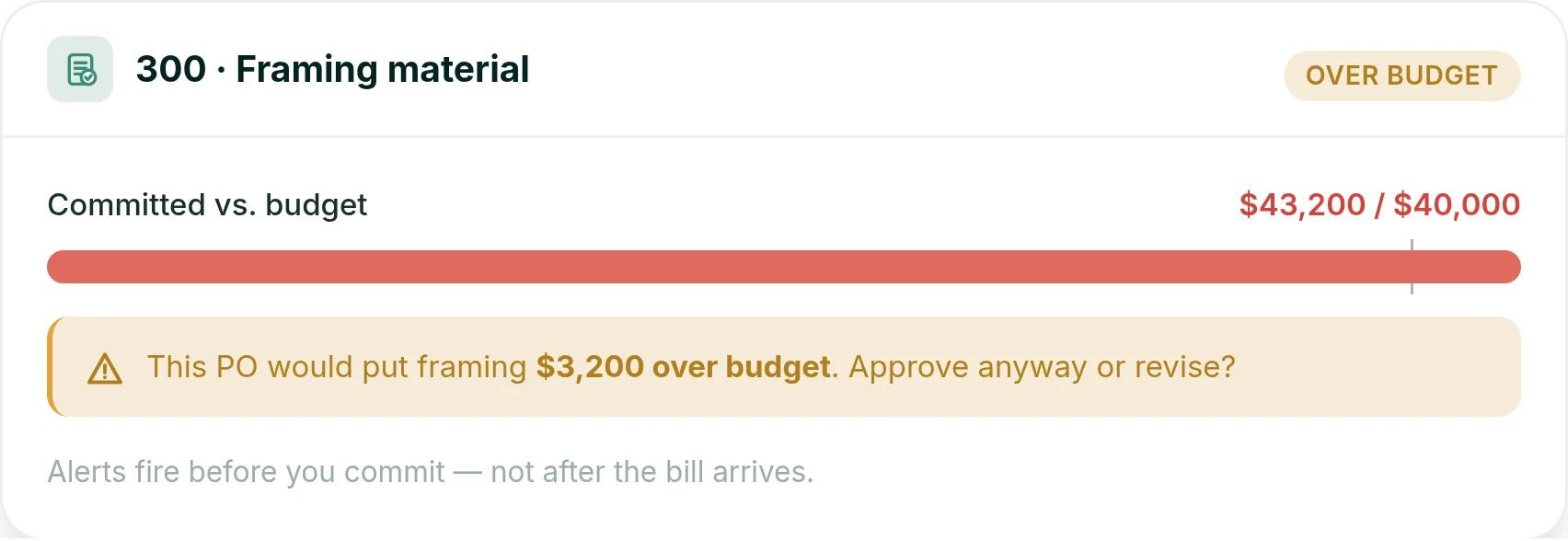
A draw schedule only protects cash flow if you can see what you have already committed against the next milestone. In Ressio, a job's budget shows committed cost against actual as the work lands, and purchase orders capture the spend that is promised but not yet invoiced. That gap, committed but unbilled, is the money a builder is fronting between draws.
Where Draw Schedules Go Wrong
Change orders are not in the schedule. A signed change order adds cost and often adds work before the next milestone, but the draw amounts were fixed at contract. Unless the change order states how and when it is paid, the builder funds it and waits.
Milestones that do not match the build sequence. Copying a template for a slab-on-grade build onto a basement build puts a draw behind work that happens weeks later than the schedule assumes.
Vague triggers. "Framing complete" invites a dispute about whether that includes the roof deck. The trigger should name the inspection or the document that proves it.
No allowance for weather or supply delays. A schedule with no float turns a two-week material delay into a missed draw, and a missed draw is a cash-flow problem rather than a schedule problem.
Draw Schedule, Schedule of Values, Progress Billing: What Is the Difference?
These get used interchangeably and are not the same thing. A draw schedule is the payment timetable, usually lender-driven on residential work.
A schedule of values breaks the contract sum down line by line across trades and cost codes, which is what a progress claim is measured against. Progress billing is the act of invoicing for work completed to date, commonly against that schedule of values.
A residential builder mostly lives in draw schedules. A commercial contractor mostly lives in schedules of values and AIA-style progress billing. Knowing which language a lender or client is using saves a fair amount of confusion at contract stage.
Draw Schedule vs Schedule of Values vs Progress Billing
| Term | What it is | Who writes it | Where you see it |
|---|---|---|---|
| Draw schedule | A payment timetable tied to milestones | Usually the lender, sometimes the builder | Residential construction loans |
| Schedule of values | A line-item breakdown of the contract sum | The contractor | Commercial contracts and AIA billing |
| Progress billing | Invoicing for work completed in a period | The contractor | Commercial and larger residential jobs |
Running Draw Schedules Without Spreadsheets
The schedule itself is a contract document. What makes it survive a build is whether the numbers behind it stay current. Builders who track draws in a spreadsheet end up reconciling three versions of the truth: the lender's schedule, the job budget, and whatever was last invoiced.
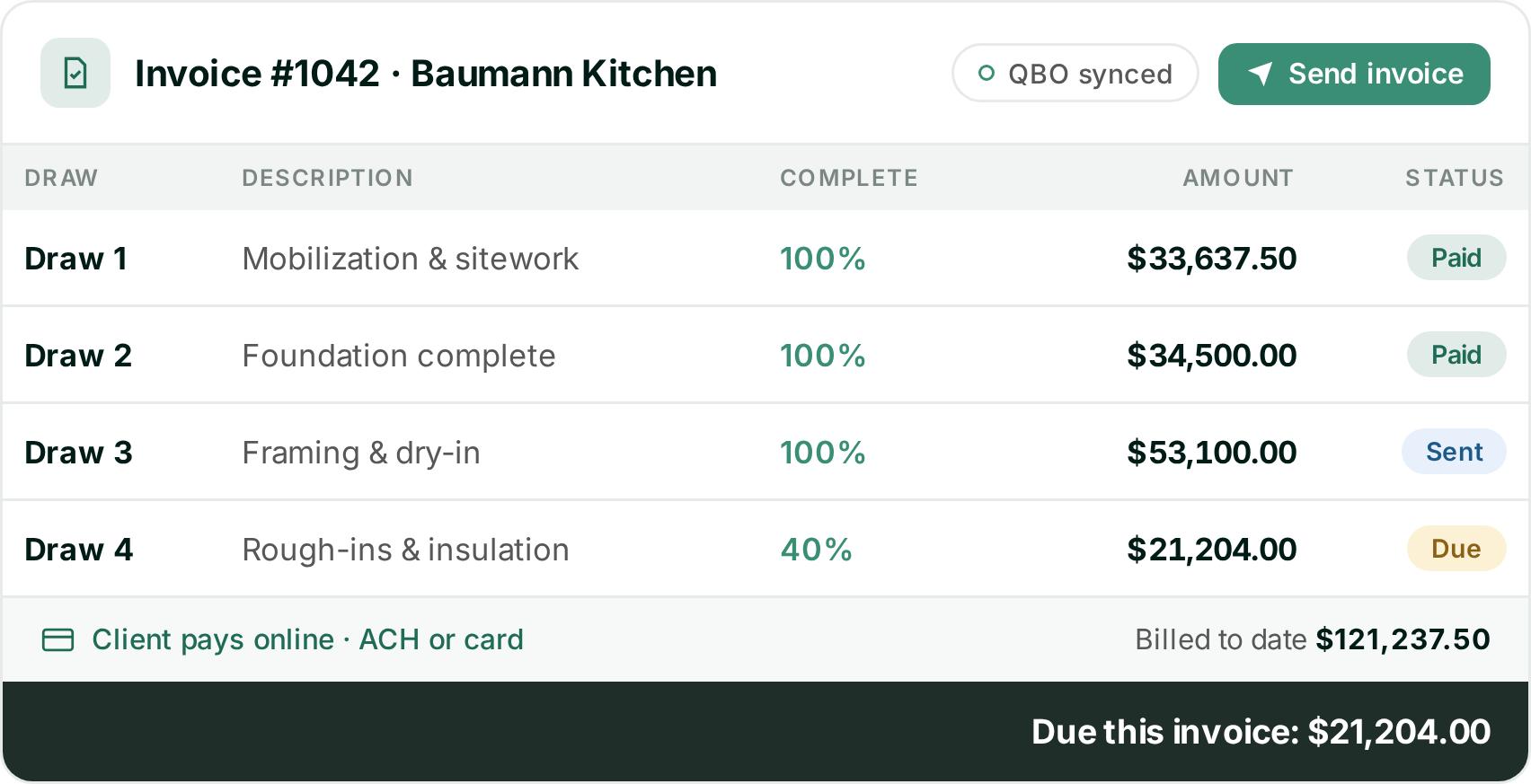
In Ressio those three are one record. You set the billing method once when you set up the project, as a draw schedule tied to project phases, and every invoice is generated from the job budget.
The contract value, approved change orders and retainage are already in the number before you send it. Each draw shows whether it is paid, sent or due, and the homeowner can pay online by ACH or card.
Want to see committed cost and every draw on the same job? Book a Ressio demo and see what you are fronting between draws before the next one is due.
Here is how that plays out on a hypothetical job. A builder is about to bill draw 3, framing and dry-in, on a kitchen and addition, and two weeks earlier the homeowner approved a $3,400 change order to move a window from their phone. On a spreadsheet, that change waits for someone to remember it at invoicing time.
In Ressio, the approval updated the contract value in the budget when it happened, so the draw 3 invoice already carries it. The purchase orders on the framing lines show how much is committed but not yet billed, before the builder decides whether to push for an earlier inspection.
That reconciliation is what construction2style described before moving to Ressio: forecasting jobs and cash flow “meant pulling from multiple places.” In their words, forecasting across the business was “a capability the team didn’t have before.”
Getting paid late is rarely one missed draw. It is a schedule that stopped matching the job weeks earlier. We wrote more on that in why custom builders wait too long to get paid.
The Takeaway
A draw schedule is not administrative paperwork; it decides who finances the build. Milestones that reference real inspections, a deposit sized to actual pre-draw spend, explicit payment windows, and change orders that carry their own terms are the difference between a project that funds itself and one a builder funds and hopes to recover.
Frequently Asked Questions
How many draws are in a typical residential construction loan?
Most residential construction loans use five to ten draws. Fewer, larger draws are easier to administer but leave the builder carrying more cost between payments; more, smaller draws improve cash flow but mean more inspections and more paperwork.
Who inspects before a draw is released?
On a financed build, the lender sends an inspector or appraiser to confirm the milestone before releasing funds. Some lenders accept photographic evidence for smaller draws. On a homeowner-funded build there may be no third-party inspection at all, which is why the trigger needs to reference something objective.
Can a draw schedule be changed mid-project?
It can, but it takes agreement from whoever is releasing the funds, and on a financed job that means a lender amendment rather than a conversation. It is far easier to build float into the schedule at signing than to renegotiate it in month four.
What happens to the draw schedule when a change order is approved?
Nothing automatically, and that is the trap. The change order needs to state its own payment terms: added to the next draw, invoiced separately, or paid on approval. If it is silent, the builder has agreed to do extra work on the original payment timetable.
What is retainage and how does it affect the final draw?
Retainage is a percentage of each draw held back until the project is complete, often 5 to 10 percent. It accumulates, so the final payment is larger than the final milestone suggests, and it arrives after completion, sometimes well after. Builders who plan cash flow on milestone amounts alone are surprised by this once.
Ready to run your construction draw schedule without spreadsheets? Book a free Ressio demo and see the budget, purchase orders and draw invoices on one job.