
Home Builder Warranty Template: Coverage, Tiers and Claims
A fill-in home builder warranty template with the 1-2-10 coverage tiers, the exclusions to name, and a warranty claims process you can run from the job record.

Ressio Staff
October 9, 2026
A home builder warranty template is the written promise you hand a buyer at closing. It says what you will fix, for how long, and how the homeowner asks for it. A good one heads off most warranty arguments before they start, because both sides read the same terms.
This guide gives you a free builder warranty template with fill-in wording, the three coverage tiers most builders use, the exclusions to name, and a claims process. It also shows how we at Ressio keep the warranty and every claim on the same job record you built the house from, so nothing about the home lives in someone's inbox.
What is a home builder warranty?
A home builder warranty is the builder's written promise to repair defects in a new home for a set period after closing. It names what is covered, how long each kind of coverage lasts, what is excluded, and how the owner files a claim. It is separate from manufacturer warranties on appliances and from homeowner's insurance.
HUD calls its one-year version the Warranty of Completion of Construction. HUD notes it is "sometimes referred to as a builder's warranty." It covers major parts of the home, such as the structure, roof, heating, windows and electrical systems.
Insurance and a warranty do different jobs. Insurance pays for sudden damage from an outside event, like a storm. A warranty covers defects in how the home was built.
What does a residential builder warranty cover?
Most residential builder warranties split coverage into three tiers: one year for workmanship and materials, two years for major systems, and ten years for structural defects. Builders call this a 1-2-10 warranty. The tiers exist because a cracked tile shows up in months, while a foundation problem can take years to appear.
| Tier | Typical length | What it covers | Examples |
|---|---|---|---|
| Workmanship and materials | 1 year | Defects in finishes and how they were installed | Drywall cracks, nail pops, trim gaps, sticking doors, grout cracks |
| Systems | 2 years | Defects in the home's distribution systems | Supply and drain lines, HVAC ductwork, electrical wiring |
| Structural | 10 years | Defects in load-bearing parts of the home | Foundation, floor framing, walls, beams, columns, roof framing |
The structural list above comes from HUD's own description of long-term warranties. HUD dropped its rule requiring a 10-year protection plan on some FHA loans in March 2019, but kept the one-year builder warranty. So the 10-year tier is now your choice, or your third-party warranty provider's.
Many builders also tie the warranty to the NAHB's Residential Construction Performance Guidelines. The sixth edition has over 340 guidelines in 13 categories.
NAHB describes them as recommendations for how a home should perform during the warranty period. Citing them gives you and the owner a shared standard for what counts as a defect.
Free home builder warranty template
Copy the builder warranty template below and fill in the brackets. Warranty law and repose periods vary by state, so the brackets mark the terms your contract and your state set. Keep every section, because each one answers a question a homeowner will ask.
What the warranty covers
- Parties and home. This Limited Warranty is given by [Builder name] ("Builder") to [Owner name] ("Owner") for the home at [address], with a warranty start date of [closing date / certificate of occupancy date].
- Workmanship and materials (1 year). For [12] months from the start date, Builder will repair defects in workmanship and materials supplied or installed by Builder or its subcontractors, measured against [the NAHB Residential Construction Performance Guidelines, current edition].
- Systems (2 years). For [24] months from the start date, Builder will repair defects in the plumbing, electrical, and heating and cooling distribution systems.
- Structural (10 years). For [10 years] from the start date, [Builder / third-party warranty provider name] will repair structural defects in load-bearing elements: foundation, floor framing, load-bearing walls, beams, columns and roof framing.
- Manufacturer warranties. Appliances, fixtures and equipment carry their makers' warranties. Builder will pass these to Owner at closing and is not the warrantor for them.
- Exclusions. This warranty does not cover: normal wear; damage from Owner neglect or lack of maintenance; changes made by anyone other than Builder; minor cracks within the performance guidelines; landscaping; weather events and acts of nature; and [other exclusions].
Filing and handling a claim
- How to file a claim. Owner will report warranty items in writing through [Builder's client portal / email address], with photos where possible. Except for emergencies, Owner will batch non-urgent items for review at [60 days] and [11 months] after the start date.
- Emergencies. For loss of heat, a major water leak or an electrical hazard, Owner will call [emergency number] at once.
- Builder's response. Builder will acknowledge each claim within [__] business days and inspect within [__] business days. Builder will decide whether to repair or replace and will schedule the work with Owner.
- Access. Owner will give Builder and its subcontractors reasonable access during normal working hours to inspect and repair.
Transfer, disputes and signatures
- Transfer. This warranty [does / does not] transfer to a later owner of the home.
- Disputes. Disputes over this warranty will be resolved by [mediation / arbitration under the rules of ______] before any lawsuit.
- Signatures. Builder: ____________ Date: ______ Owner: ____________ Date: ______
How does a builder warranty claims process work?
A builder warranty claims process has five steps: the owner reports the item, you log it, you inspect, you assign the repair, and you close it with the owner's sign-off. The hard part is keeping every claim on one list, with a clear owner and a date, for up to ten years.
- Report. The owner sends the item in writing, with photos.
- Log. You record it against the home, with the date it came in.
- Inspect. You confirm whether it is a covered defect under the warranty terms.
- Assign. You send the repair to your team or to the trade who did the work.
- Close. The repair is done, the owner confirms, and the record stays on the job.
Most builders schedule two walkthroughs: one around 60 days after move-in and one before the one-year mark. Batching items this way cuts trips to the house. It also catches problems before the workmanship tier ends.
Where builder warranty claims break down
Builder warranty claims break down when the warranty, the claims and the job history live in different places. The signed warranty sits in a folder.
Claims come in by text and email. And the record of who did the work, what the client chose and what changed is buried in a closed job.
Budget for it, too. HUD's review cites a Warranty Week finding that builders in 2015 set aside $2,500 per new home for warranty claims, most of it spent in the first year or two. A claim lost in a text thread costs you that money twice: once to fix it late, and again in the owner's review of you.
The usual way to run warranty work is a spreadsheet and an inbox. That works for a few homes. Past that, you lose track of which sub owes which callback, and the 11-month walkthrough turns into a hunt for photos from closing.
Here is how that plays out in Ressio on a hypothetical custom home that closed in March.
In October, the owner messages through the portal with a photo of each of three items: a dripping shower valve, nail pops in the hallway, and a back door that sticks. You add three to-dos on the project. The shower valve goes to the plumber, who gets a magic link with the owner's photo and confirms for Thursday.
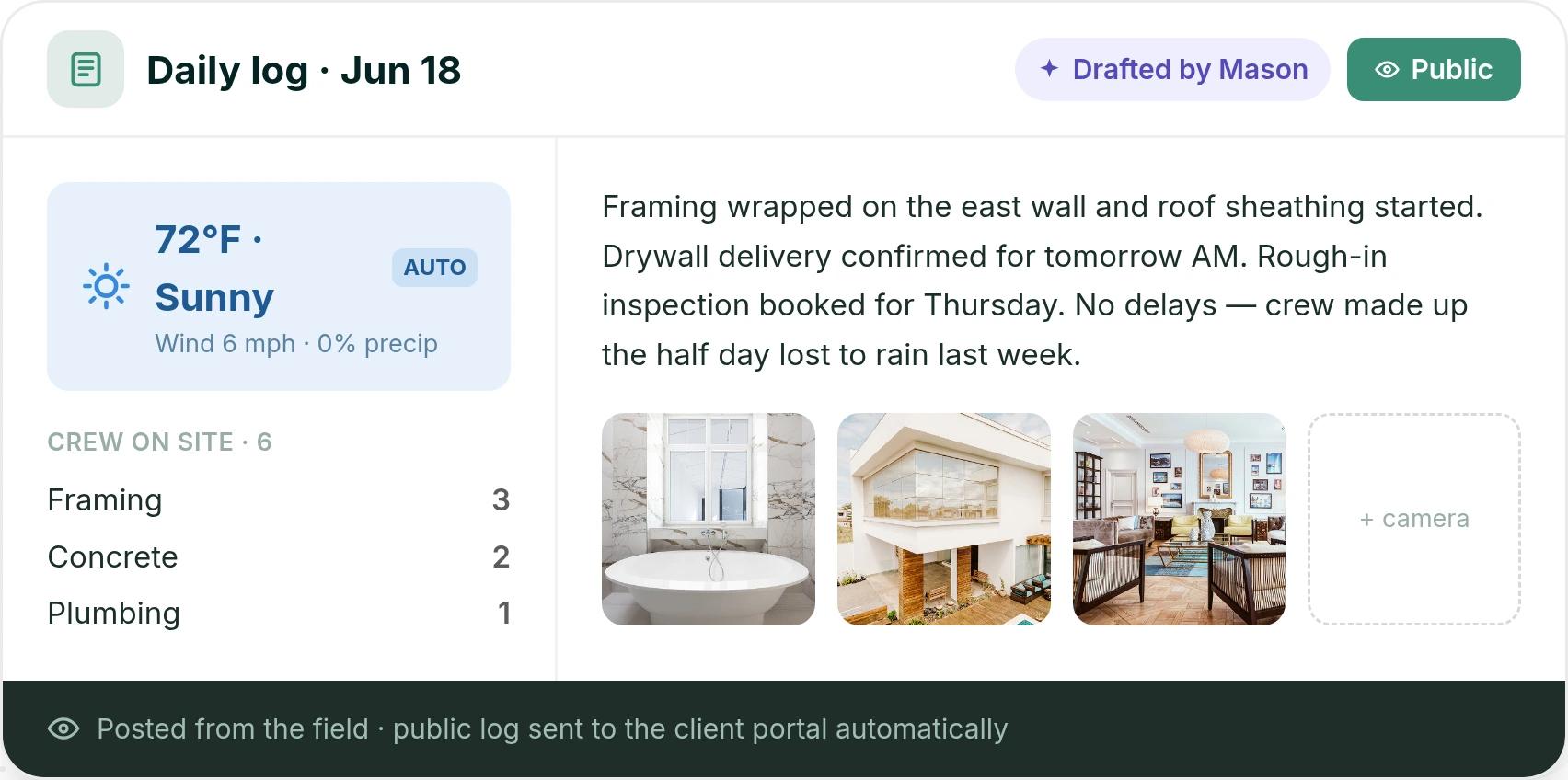
If a callback slips, it shows in your overdue tasks across every home. By Friday, all three are marked done from the field and timestamped on the job. They sit next to the daily logs and photos from the build, so the 11-month walkthrough starts from the record, not a hunt.
How we keep the warranty with the job record in Ressio
In Ressio, the warranty and every claim stay on the same project you built the home from. The documents, the client's approvals, the daily logs and the subs are already there. So when a claim comes in, you are working from the full history of the house, not rebuilding it.
Warranty claims become to-dos on the job
Log each claim as a task with our to-do lists. Every to-do lives on a specific project, so the warranty items for a home sit with that home.
You assign each one to a team member or a sub, and they get notified. When it is done, it is timestamped on the project, so you have a trail of what was fixed, who fixed it, and when.
You can filter open tasks by project, assignee or due date. And you can see every overdue task across your homes at a glance, which is how a forgotten callback gets caught before the owner calls you.
Subs see the repair without a login
Send the repair to the trade who did the work through our vendor portal. The sub gets a magic link, sees the task and the attached photos, and confirms it.
No account, no password and no "can you resend that?" call. They can message you on the task, and their scope is all they see.
The homeowner has the warranty in the portal
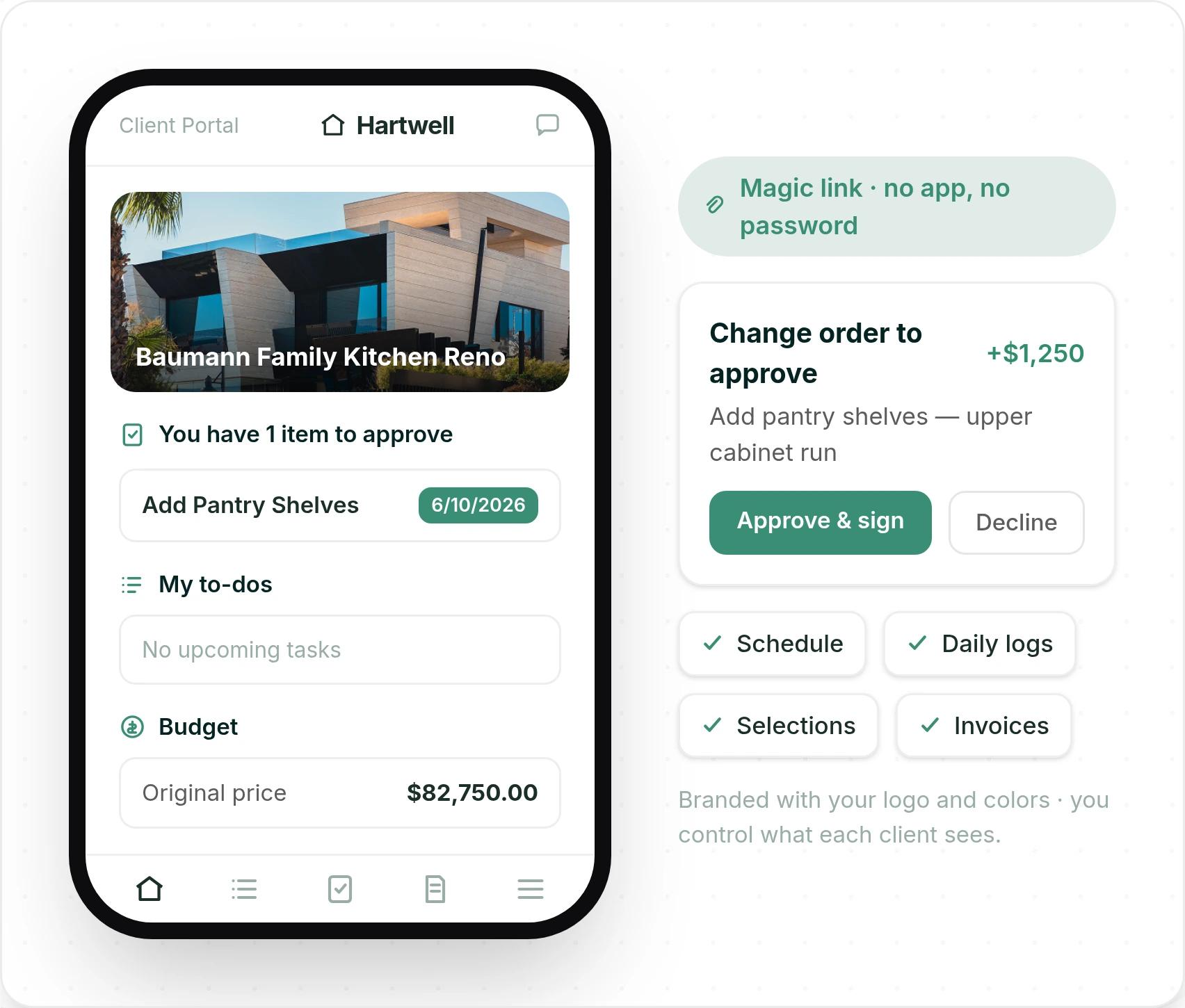
Share the signed warranty in the client portal. The owner opens it from a magic link on any phone, with no password to forget.
The portal shows what you have shared: the schedule, logs, documents and invoices. And through our messaging, each message stays attached to the item it is about, with photos and files in the thread.
The job history settles "was it built that way?"
Many warranty disputes come down to what was agreed. Our selections and approvals keep a timestamped record of what the client approved.
Change order history stays attached to the project for closeout. And daily logs with photos can be exported for your closeout package.
Want to see a warranty claim run from the portal to a closed to-do? Book a Ressio demo and we will walk one through on a real job.
What to include with the warranty at closing
Hand over a closeout packet with the builder warranty template signed, plus the documents the owner will need to file a claim. A complete packet saves calls in the first year, because the owner can answer most questions alone.
- The signed builder warranty and the date coverage starts
- Manufacturer warranties and manuals for appliances and equipment
- The final selections list, with paint colors and finish names
- The completed punch list
- A short maintenance schedule the owner is responsible for
- How to file a warranty claim, and the emergency number
The warranty period starts at closing, which is the last stage of the custom home building process.
Get your warranty and your job record in one place
A home builder warranty template sets the promise. Keeping it is about having every claim, every photo and every approval on the same record as the house. Book a Ressio demo and see how warranty claims, subs and homeowners stay on one job, from the first estimate to the last callback.
Frequently Asked Questions
What should a home builder warranty include?
A home builder warranty should include the parties and the home, the start date, coverage by tier (workmanship, systems and structure), how long each tier lasts, exclusions, how to file a claim, emergency contacts, the builder's response times, transfer terms and a dispute process.
How long is a typical new home builder warranty?
Many new home builder warranties follow a 1-2-10 structure: one year on workmanship and materials, two years on plumbing, electrical and HVAC systems, and ten years on structural defects. HUD's own builder warranty, the Warranty of Completion of Construction, runs for one year.
Is a 10-year structural warranty required?
No federal rule requires a 10-year structural warranty on most new homes. HUD removed its 10-year protection plan requirement for certain FHA loans in March 2019 and kept only the one-year builder warranty. Lenders, state law or your contract may still call for longer coverage, so check what applies to your market.
What is not covered by a builder warranty?
A builder warranty usually excludes normal wear, damage from owner neglect or poor upkeep, changes made by others, weather events, landscaping, and minor cracks within accepted performance standards. Appliances and equipment are covered by their makers' warranties instead. Name each exclusion in writing, so the owner knows before a claim comes in.
How do builders track warranty claims?
Builders track warranty claims by logging each item against the home, assigning it to the right trade, and recording when it was fixed. In Ressio, each claim is a to-do on the project, subs get the task by magic link, and every completed item is timestamped on the job record.