What RessioCon Taught Me About Who Really Drives Adoption
My team can build the software, but only builders can help builders overcome some of the hardest problems they face.

Mitchell Kasselman
In the early days of Ressio, I spent as much time as I could with our first customers, learning how their businesses actually ran. One builder even let me work alongside their team and copied me on every client email thread for a custom home project. It was during this period that, one Saturday night at around 11:30, ten of these replies hit my inbox across different threads, one after another.
I’d asked for a front-row seat, so I couldn’t complain, but I remember thinking about what the builder's Sunday was going to look like. Reading through all of it. Figuring out which question tied to which decision. Copying the important parts back into the project management system so nothing slipped. That's a lot of stress for work that has nothing to do with building a home.
I knew software could help put every one of those messages in one place, tied to the right project and the right decision, with nothing to copy over by hand. But it would only work if everyone, the client included, used it instead of defaulting to emails and texts.
Years later, that software exists. But getting everyone to use it is still a challenge.
Why adoption is the hard part
We can keep making the software better every two weeks, but it doesn't mean anything unless builders (and everyone they work with) are actually using it.
In one of my favorite books, Atomic Habits, author James Clear makes the point that when things get busy, people fall back to the level of their systems. I see that happen with builders and their software. When the whole job runs through Ressio, from a client’s first question to the final invoice, the weekly client recap that used to take an hour takes just a couple of minutes. Plenty of teams get there and start cruising. Then a busy month hits, and old habits creep back in.
Those habits belong to everyone on the job. Superintendents have to keep posting the daily log. Project managers have to stop answering client questions by text. Clients have to send their questions somewhere other than the PM’s cell phone.
When any of that slips, the cost shows up everywhere. Half the job lives in the system and the other half lives in texts, emails, and someone’s memory. The owner is paying for software while still running the business the old way: re-entering information, chasing down what was decided, and finding out about problems too late.
My team helps with a lot of this through implementation, training, and support. But day to day, it’s the builder who sets the tone for their crew and their clients. That’s why the two sessions that stuck with me most at RessioCon, our user conference in Washington, D.C. this past October, were builders explaining how they got their own clients and crews on board.
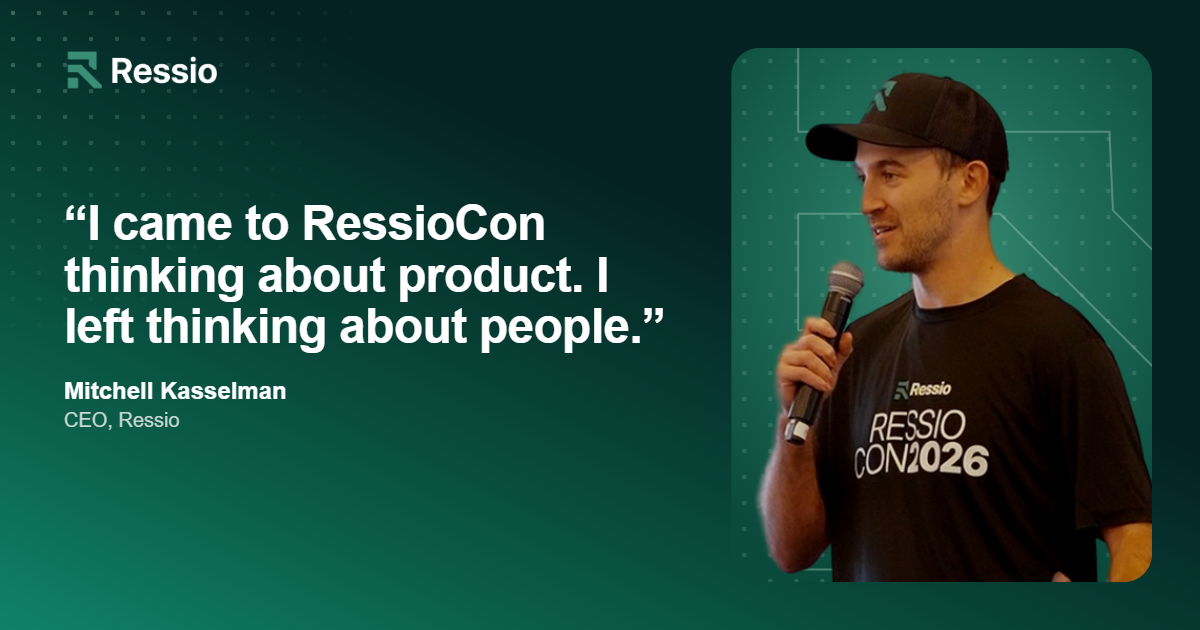
I came to RessioCon thinking about product. I left thinking about people.
Dan: clear expectations from day one
Dan DeVol of DeVol Builders, one of our longtime customers, told the room he doesn't accept text messages from clients. Every message goes through Ressio. That's the policy. If a client won't agree to it, he won't take them on.
He backs it up with a one-page document every client gets that lays out how they'll work together.
From what I've seen, it strengthens his pitch for new business. It tells clients he knows what he's doing and that they're going to get a well-run project. The clients who push back on it, in Dan’s view, tend to be the price shoppers, the ones who would have been the hardest to work with anyway.
For Dan, a big part of it is peace of mind. His clients can send a message anytime, and he responds during set hours. Nobody is texting him at 11:30 on a Saturday night. Clear boundaries, clear expectations, and a little more sanity.
I'm sure it took work to get there. Dan had to change habits, for his own team and for clients who were used to texting him. But now that he's on the other side of it, it's paying off, and the room at RessioCon could tell. Builders kept asking him follow-up questions during the panel, and dozen more came up to him afterward wanting to know how he made it work. It was inspiring to watch builders helping other builders.
Dan's standard has made us better, too. A builder who runs every client conversation through our messaging holds us to a high bar, and the product is stronger for it.
Desi: making it part of the job
Desi Gehl, Integrator & Executive Assistant at Waldmann Construction, took on the other side of the problem: getting her own crew on board. It’s one of the biggest blockers we see.
She wanted daily logs from the field, and she knew how much friction a new app could create for a crew. But she also knew that Mason, Ressio’s AI assistant, could read documents, and how much hassle that could save in the long run.
So she designed a simpler workflow: her team would fill out a daily log template on paper, take a photo, and let Mason read it and post the log in Ressio. The crew could keep a habit they already had, and the business would get the benefit of automation.
The question was how to get them to actually do it. She trained the team in a weekly meeting. From then on, it was expected. It went into the job description and was tied to pay, including an extra transportation stipend for the people who followed through. If it didn’t get done, they lost out on the perk and would see it show up on their performance reviews.
Everything about her approach was deliberate. She decided on the behavior, made it easy, and then reinforced it. And it worked: her team went from barely using Mason to being among the most active of any Ressio customer. That means daily logs actually get posted, the office knows what happened on site without chasing anyone down, and the crew isn’t stuck typing up notes at the end of a long day.
What this means for us at Ressio
Years ago, I visited Halm & Perkins, a small family-owned builder in an office outside Lansing, Michigan. Owners Joe and Lisa Dannenberg were skeptical of project management software and didn’t use any themselves but believed in our mission enough to give us a try. They became one of our earliest customers, and at the happy hour on the first night of RessioCon, there they were, now running a growing business out of Okemos and talking shop with builders who had just signed on.
I asked them if they ever thought we’d actually be here, seeing this thing we’d imagined become real. And to my surprise, the answer was yes. They’d believed since year one that we’d reach this milestone someday, and it made me reflect on who really makes this work.
My team can build the software, but some of the hardest problems our customers face – getting a crew to post daily logs or getting clients off text messages – sit outside the software in how a builder runs their business. Builders like the Dannenbergs depend on builders like Dan and Desi for their own answers to these problems. They know people, and that’s not something we can ship.
I’m grateful to every builder who got on that stage or stayed after to answer one more question. Our theme for RessioCon was “Build better, together.” Watching them, I understood the “together” part better than I did going in.
We’ll keep building the best software we can to solve problems like that Saturday night inbox. And we’ll keep making room for builders like Dan and Desi to show other builders how to get their crews and clients on board. If you’ve gotten your crew or your clients to change how they work, I’d like to hear how you did it. And if you’d rather tell a room of builders, RessioCon 2027 is already in the works.