
Subcontractor Agreement Template for Home Builders
A subcontractor agreement is the written contract between a builder and a trade partner. It sets out the scope of work, the price, how and when the sub gets paid, the schedule, insurance, and what happens when something changes or goes wrong. The subcontractor agreement template below covers the 16 clauses a residential builder needs, with fill-in wording for each, followed by the checks to run before any sub signs and starts work.

Ressio Staff
October 10, 2026
This is a starting point, not legal advice. Payment, lien, indemnity and licensing rules differ from state to state, so have a construction attorney review your final version once, then reuse it on every job. We build Ressio, the construction management software for custom home builders, and the last section shows how we keep a signed agreement and the running job in step.
Why a written subcontractor agreement matters
Most disputes with subs come down to one of three things: what was included in the scope, when payment was due, and who pays to fix a problem. A handshake deal leaves all three open to memory. A signed agreement settles them before work starts, when both sides are still agreeable.
A written construction subcontractor agreement also protects the builder from risks that have nothing to do with the relationship. If a sub's worker is injured on your site and the sub has no workers' compensation cover, or a sub's supplier goes unpaid and files a lien against your client's home, the agreement and the paperwork it requires are what stand between that problem and your business.
What to include in a subcontractor agreement
Every subcontractor agreement template should cover these 16 clauses:
- Parties and project details
- Scope of work
- Contract price
- Payment terms and schedule
- Retainage
- Schedule and delays
- Change orders
- Insurance
- Indemnification
- Licensing, permits and compliance
- Safety and site rules
- Quality, warranty and callbacks
- Lien waivers
- Independent contractor status
- Termination
- Dispute resolution
Subcontractor agreement template
Copy the wording below into your own document and replace everything in square brackets. Keep the clause headings, so both sides can find a term fast when a question comes up mid-job. If you work on AIA contracts, the AIA also publishes the A401 Contractor and Subcontractor Agreement, which passes the duties in your contract with the owner down to the sub.
- 1. Parties and project. This Subcontractor Agreement is made on [date] between [Builder legal name], [address] ("Contractor"), and [Subcontractor legal name], [address], [license number] ("Subcontractor"), for work at [project address] for [owner name] (the "Project").
- 2. Scope of work. Subcontractor will furnish all labor, materials, equipment and supervision needed to complete the following work: [trade and detailed description], as shown in [drawing numbers, specification sections and revision dates]. The following items are excluded: [exclusions]. Work not described here is not included unless added by a signed change order.
- 3. Contract price. Contractor will pay Subcontractor [fixed price $____ / unit rates listed in Exhibit A / time and materials at the rates in Exhibit A, not to exceed $____] for the work described in Section 2.
- 4. Payment terms. Subcontractor will invoice [monthly on the __ day / at the milestones in Exhibit B]. Each invoice must show the work completed and include a conditional lien waiver for the amount requested. Contractor will pay approved invoices within [__] days of [receipt / Contractor's receipt of payment from the owner for that work].
- 5. Retainage. Contractor will hold back [__]% of each payment as retainage, released within [__] days after final completion, acceptance of the work, and receipt of final unconditional lien waivers from Subcontractor and its suppliers.
- 6. Schedule and delays. Subcontractor will start work on [date or trigger] and complete it by [date or duration], following Contractor's project schedule. Subcontractor will give written notice within [__] days of any event it believes will delay the work, with the reason and the expected impact.
- 7. Change orders. No change to the scope, price or schedule is valid unless both parties sign a written change order before the changed work begins. Each change order will state the added or deducted work, the price adjustment and any schedule adjustment.
- 8. Insurance. Before starting work, Subcontractor will provide certificates of insurance showing commercial general liability of at least [$____ per occurrence / $____ aggregate], commercial auto liability of at least [$____], and workers' compensation as required by law, with Contractor [and Owner] named as additional insured on the general liability policy. Subcontractor will keep this coverage in force until the work is complete and give notice of any cancellation.
- 9. Indemnification. To the extent permitted by law, Subcontractor will indemnify and hold harmless Contractor [and Owner] from claims, damages and costs arising from Subcontractor's work, or from the acts or omissions of Subcontractor, its employees, or its lower-tier subcontractors and suppliers.
- 10. Licensing, permits and compliance. Subcontractor holds all licenses required for its trade in [state] and will obtain the permits and inspections for its own work [or: Contractor will obtain permits; Subcontractor will schedule and attend its inspections]. Subcontractor will comply with all applicable codes, laws and the project drawings.
- 11. Safety and site rules. Subcontractor is responsible for the safety of its own workers and will follow applicable safety regulations and Contractor's site rules, including [working hours, parking, site access, and daily cleanup of its own debris].
- 12. Quality and warranty. Subcontractor warrants that its work will be free from defects in workmanship and materials for [one year / __ months] from [substantial completion / owner move-in], and will correct warranty items within [__] days of written notice.
- 13. Lien waivers. Subcontractor will provide a conditional lien waiver with each payment request and an unconditional lien waiver for each payment received, and on request will provide waivers from its own suppliers and lower-tier subcontractors.
- 14. Independent contractor. Subcontractor is an independent contractor. It controls the means and methods of its work and is responsible for its own employees, wages, taxes and benefits.
- 15. Termination. Contractor may terminate this agreement if Subcontractor fails to perform and does not cure the failure within [__] days of written notice. Either party may terminate for [other agreed reasons]. On termination, Subcontractor will be paid for work properly completed to that date, less any costs Contractor incurs to complete or correct the work.
- 16. Dispute resolution. The parties will first try to resolve any dispute by direct negotiation. If that fails within [__] days, the dispute will go to [mediation, then binding arbitration / the courts of ______ County, ______]. This agreement is governed by the laws of [state].
Signed: [Contractor name, title, signature, date] and [Subcontractor name, title, signature, date].
Attach the drawings, specifications, any unit-rate or milestone exhibits, and the certificates of insurance, and reference them by name in Section 2.
Clauses builders most often get wrong
Scope written as a trade name instead of a list. "Framing" is not a scope, so name the drawings and revision dates, list what is excluded, and say who supplies materials. Most change-order arguments start with a scope that was too short to settle anything.
Pay-when-paid wording that the state will not enforce. Tying a sub's payment to the owner paying you is common, but some states limit or refuse to enforce clauses that make owner payment a condition of paying the sub at all. Check how your state treats them before relying on one.
Indemnity that is too broad. Many states have anti-indemnity laws that void a clause requiring a sub to cover losses caused by the builder's own negligence. "To the extent permitted by law" helps, but it is no substitute for having the clause reviewed.
Insurance collected once and never checked again. A certificate shows the coverage on the day it was issued. Track the expiry dates and ask for renewed certificates before a policy lapses mid-job.
Retainage with no release trigger. Say exactly what releases the holdback and when, or the final payment becomes its own dispute.
Before a sub signs: a quick checklist
- Legal name, address and license number match the sub's license record
- Scope names the drawings, specifications and revision dates
- Exclusions are written down
- Price, payment timing and retainage are filled in
- Start and completion dates match the project schedule
- Certificates of insurance received, with you named as additional insured
- Workers' compensation certificate or state exemption on file
- Lien waiver forms agreed
- Change order process explained to the sub's foreman, not only the owner
- Signed by someone with authority to bind each company
Keeping the agreement working after it is signed
A subcontractor agreement only protects you if the job is run the way it says. The scope in Section 2 has to match what the sub is told to build, the change order process in Section 7 has to be used every time, and payments have to follow Section 4. On most jobs the agreement is filed once and the real terms drift through text messages and phone calls.
In Ressio, we keep the job and the agreement pointed in the same direction:
- A vendor portal that shows each sub their own tasks, schedule, scope and documents through a magic link, with no account or password to set up, so the drawings they build from are the current ones.
- Purchase orders tied to the job and the budget line, so the subcontract amount is committed against the budget as soon as the PO is issued, and every bill is matched to it before you pay.
- Change orders approved by the client and carried into the budget, so when the owner changes the scope you have the signed record behind the matching change to the sub.
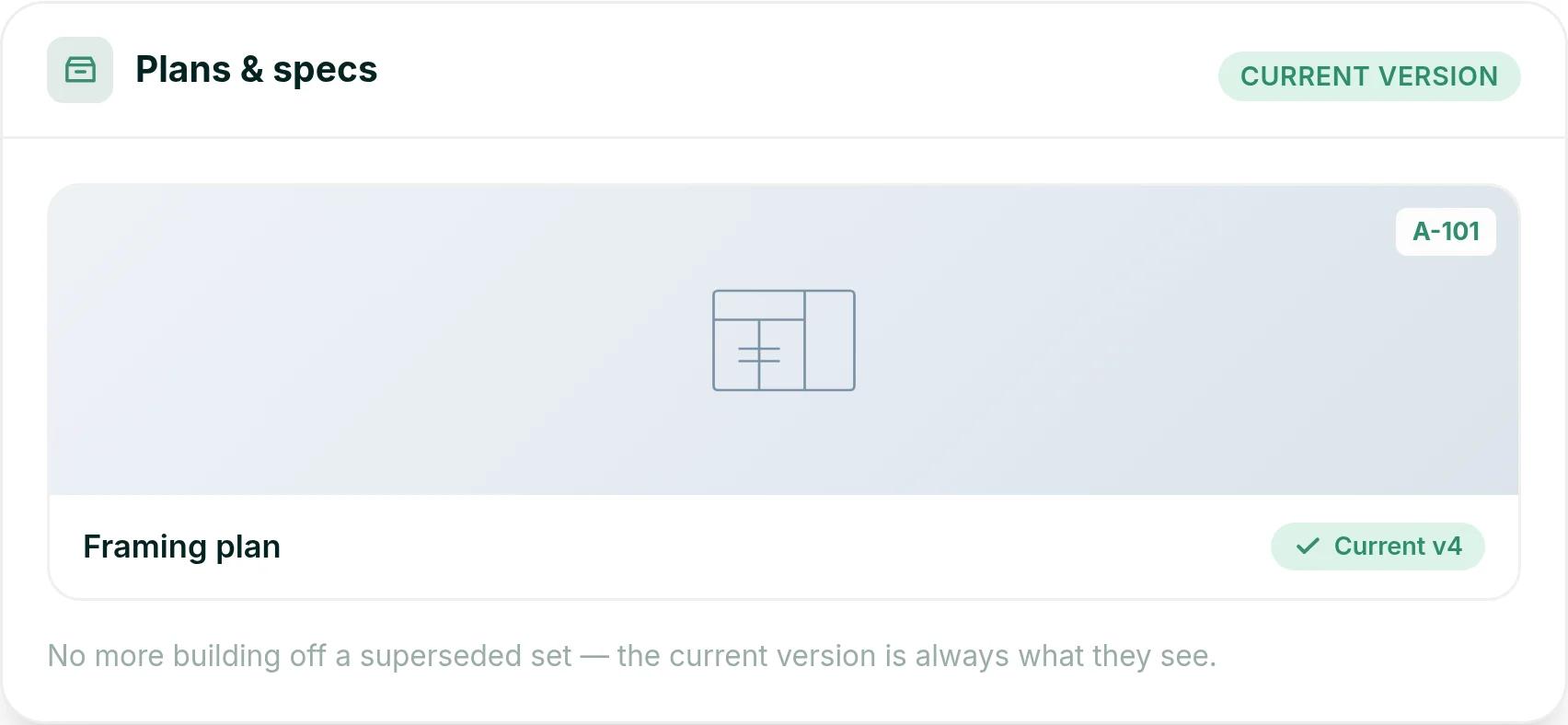
Here is how that plays out on a hypothetical framing subcontract. Section 2 names the framing plans by revision, and in our vendor portal those plans sit at their current version, so the crew opens a magic link on site and builds from v4, never last month's printout.
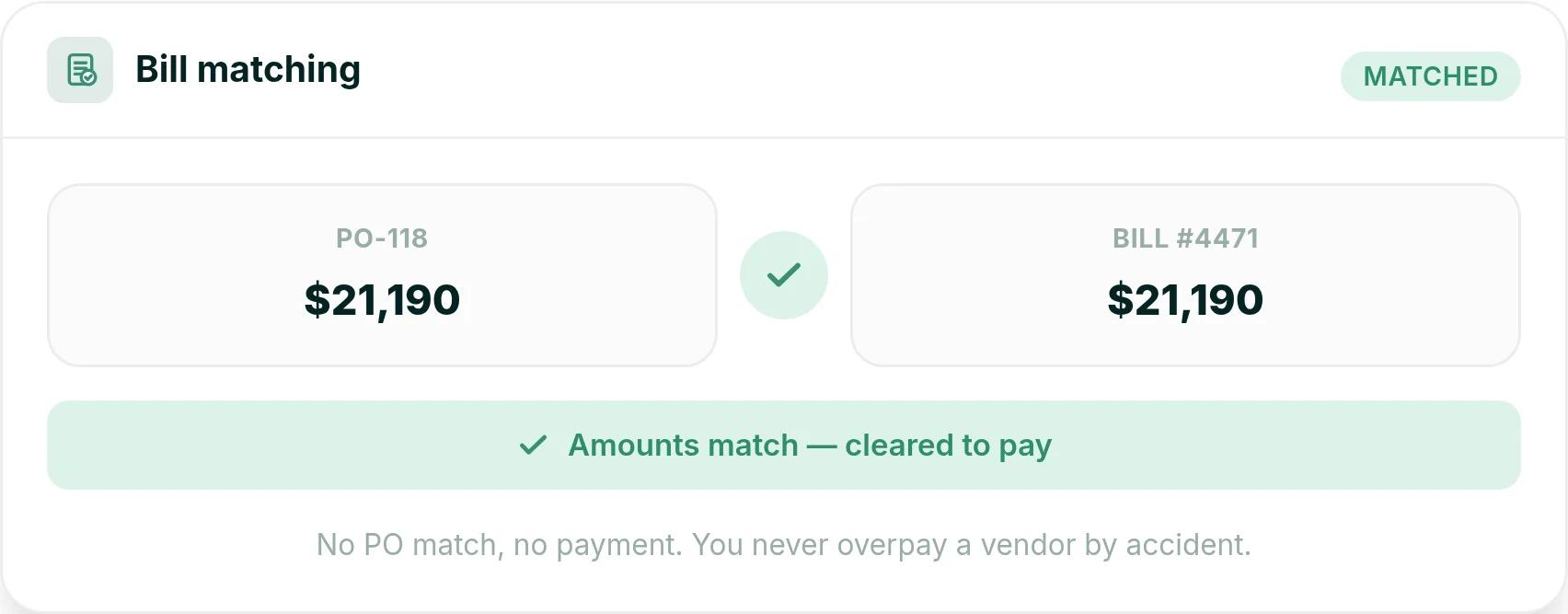
The framing lumber goes out as purchase order 118 for $21,190, committed against the framing budget line the day it is issued, and bill 4471 for the same amount is matched to it before anyone pays. When their certificate of insurance is about to expire, the sub gets a reminder with a link to upload the renewal and you are notified when they do, so Section 8 is still true in month five.
To see your next job's subs running through our vendor portal, book a Ressio demo.
For the wider system around agreements, from vetting subs to onboarding them, see how top builders protect themselves with better subcontractor systems.
Frequently Asked Questions
What should be included in a subcontractor agreement?
The parties and project, a detailed scope of work with exclusions, the price, payment terms and retainage, the schedule, a change order process, insurance requirements, indemnification, licensing and compliance, safety, warranty, lien waivers, independent contractor status, termination, and dispute resolution.
Do I need a written subcontractor agreement for small jobs?
A short job still carries the same risks: an unclear scope, a late payment, an uninsured injury, or a lien. The agreement can be shorter, but it should still settle scope, price, payment, insurance and change orders in writing before work starts.
Who writes the subcontractor agreement, the builder or the sub?
Usually the builder, because the builder is managing many subs on one project and needs consistent terms across all of them. Subs often send their own proposal or terms; decide which document controls and say so in the agreement.
Is a subcontractor agreement template legally binding?
A signed agreement is a contract, whether it started as a template or not. Whether each clause is enforceable depends on your state's law, which is why builders have their final template reviewed by a construction attorney once and then reuse it.
What is the difference between a subcontractor agreement and a purchase order?
A subcontractor agreement sets the legal terms of the relationship: scope, payment, insurance, liability and disputes. A purchase order commits a specific amount of money against the job budget. Many builders sign one master agreement with each sub and then issue a purchase order for each job or scope.