
How to scale a construction business when skilled labor is your actual constraint
Maximize your throughput with the team you already have by tackling the four most common bottlenecks for residential building companies.

Mitchell Kasselman
September 16, 2026
Most builders who want to grow think they need more deals.
I hear it constantly: "If I could just get a few more projects, we'd hit the next level."
But when I look at their business, the pipeline isn't the problem. The crew is already stretched. The subs are juggling three other jobs. The owner is the one pushing every project forward, and they're out of hours in the day.
Adding another deal to that wouldn't grow the business. It would break it.
There’s a difference between a demand problem and a throughput problem.
The ceiling isn't just how many jobs you can sell, but how many you can actually move through your team at once.
Why the Construction Labor Shortage Is Your Growth Ceiling
The numbers back this up. In NAHB's 2025 survey, 61% of builders called labor availability a serious problem. The skilled-labor shortage is now costing the home-building industry around $10.8 billion a year. An estimated 19,000 single-family homes didn't get built in 2024 because there weren't enough hands to build them.
When labor is this tight, the builders who win are the ones who can run more jobs without additional hiring, without dropping the ball, without burning out their team, and without the owner personally touching every detail.
Scaling is a throughput game. So the question is: where is your throughput actually leaking?
In my experience, it comes down to four bottlenecks. And every one of them is usually still running through you.
- Pricing speed — how fast you can lock down accurate sub pricing on a new job
- Information flow — how fast your subs and field get the plans they need
- Bench readiness — whether your vendors are vetted, compliant, and ready to go
- Visibility — whether you can see where every job is stuck across a growing portfolio
Fix these four, and you can take on more work with the team you already have.
Let's go through them.
Managing Subcontractor Bids Without the Back-and-Forth
To take on another job, you need accurate sub pricing fast.
But most builders are still chasing that pricing by text and email. You send a set of plans to four subs, wait, follow up, wait again, then hand-key whoever responds back into your estimate. Do that across one job and it's annoying. Do it across ten and it's a full-time job nobody's getting paid for.
That's the first place throughput leaks.
In Ressio, bid requests come straight off your estimate. You check the line items you want priced, send the request to one vendor or several at once, and track every response in one place. You can update a bid or add vendors even after you've released it, without recreating anything.
And when you approve a bid, the amount drops right back into your estimate, with the vendor's name attached to the line item. No re-keying. No transcription errors. No version of the budget that only lives in your head.

When pricing a new job goes from a week of phone tag to a process running in the background, estimating stops being the thing that holds up job number eleven.
Sharing Plans and Specs With Subcontractors
Here's a bottleneck nobody talks about…you become a human file server.
The more jobs you run, the more time you spend texting plans, re-sending specs, and answering "which version is current?" Every one of those messages is a small stall. Multiply it across every active job and every sub, and you've turned yourself into the slowest link in the chain.
Plan Hub takes you out of the middle.
You share a project's plans, files, and specs through a single public link or QR code. No login, no account, no friction for the trades. You control exactly which files are shared with tags, and you can share specs as read-only with no financial information exposed. Your subs and field crew search, filter, and pull the latest documents themselves.
The information moves at the speed of the job instead of the speed of your inbox. That's throughput.
Track Subcontractor COIs and Vendor Compliance
More jobs means more subcontractors. And more subs means more paperwork you can't afford to lose track of.
One expired certificate of insurance at the wrong moment can stop a job cold, or leave you exposed on liability you thought was covered. When you're running a handful of jobs, you can keep that straight in your head. When you're scaling a bench of trades, you can't.
Ressio lets you store and manage every vendor document in one place: COIs, W9s, contracts, compliance records. You add custom names, types, reference numbers, and expiration dates, and the system reminds you before anything lapses. You get an at-a-glance view instead of a manual follow-up routine that eats your week.
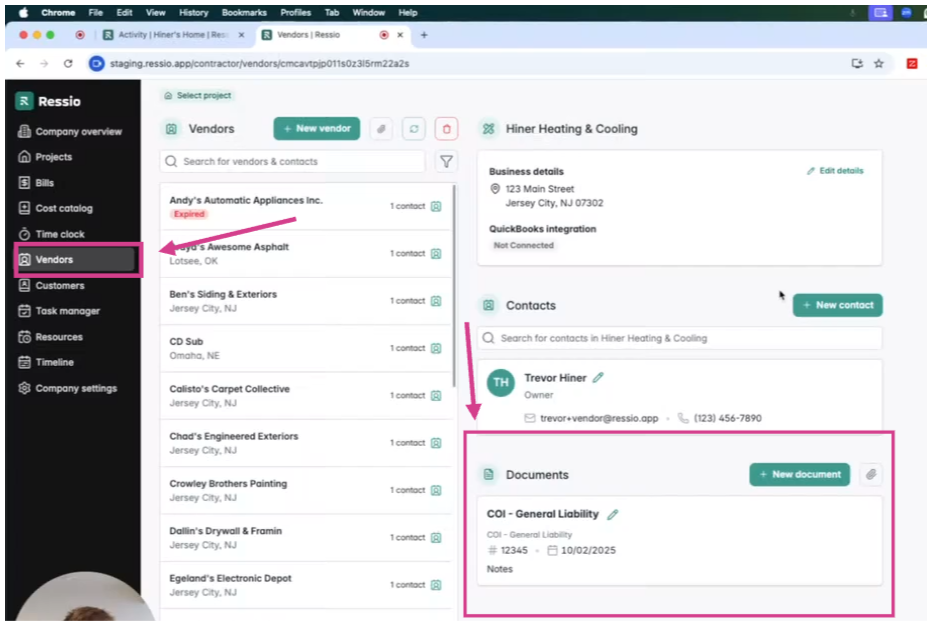
A vetted, ready-to-go bench means you can put capacity on a job the moment it needs it. No scramble. No last-minute "wait, are they even covered?"
That readiness is what lets you say yes to the next project with confidence instead of crossing your fingers.
Manage Multiple Construction Projects at Once
When you're running three jobs, you hold the whole operation in your head. You know what's stuck and what's moving.
Run twelve, and that breaks. You find out a job stalled three days ago when the client calls to ask why nobody showed up. At that point, you're not managing your business. You're firefighting it.
The Project Overview in Ressio gives you one snapshot per job: overdue approvals, unread messages, the budget summary, what's coming up, and all the recent activity like change orders and bids, organized by date. You can jump straight to whatever's stuck, and even view the job the way your customer sees it.
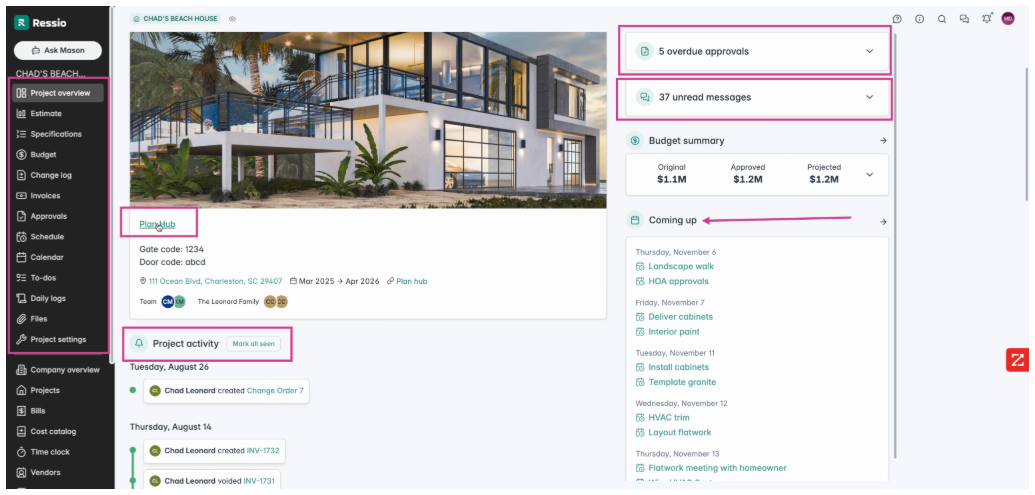
That's the difference between managing by exception and managing by emergency. You catch the stuck job before it costs you a week. And that's exactly what lets one person oversee more work at once.
How to Scale Your Construction Business Without the Chaos
Growth doesn't come from a fuller pipeline. In this market, with labor this tight, it comes from moving more work through the same team without it falling apart.
Every one of those four bottlenecks is something hundreds of builders are still doing by hand. Pricing. Information. Bench readiness. Visibility. Each one you turn into a system is one less thing that depends on you, and one more job your business can absorb without breaking a sweat.
The builders who break through their ceiling are the ones who built a business that can handle the next job before it walks in the door.
Looking to grow your business despite labor constraints? Book a Ressio demo to begin maximizing your throughput.