
What Is a Cost-Plus Contract?
Cost-plus is the standard structure for custom homes, and most disputes about it are disputes about definitions nobody wrote down. Here is how the fee works, which costs are reimbursable, and what it takes to run one well.

Ressio Staff
October 9, 2026
What Is a Cost-Plus Contract?
A cost-plus contract is an agreement where the homeowner pays the actual cost of the work plus an agreed fee for the builder. The cost is whatever the project consumes in labor, materials, equipment and subcontractors. The fee is the builder's compensation, and it is stated separately rather than buried inside a single lump-sum number.
That separation is the whole point. In a fixed-price contract the builder absorbs the difference between the estimate and the real cost, so every unknown has to be priced defensively in advance. In a cost-plus contract the real cost passes through, so the builder does not have to guess, and the homeowner does not pay for a contingency that never got used.
It is the standard structure for custom homes and large renovations, because those are the projects where nobody can know the final scope on the day the contract is signed.
How the Fee Is Calculated
Three structures cover almost every cost-plus agreement, and they allocate risk differently.
Percentage of cost. The fee is a percentage of what the project costs, commonly in the range of ten to twenty percent depending on market, project size and how much the builder is managing. It is simple to administer and it scales with the work.
Its weakness is the incentive question every homeowner eventually asks: a fee that rises with cost does not reward efficiency.
Fixed fee. The builder is paid a set amount regardless of final cost. This removes the incentive objection and works well when the scope is broadly understood even if the details are not.
The risk is scope growth: a project that doubles in size pays the builder the same fee for twice the management.
Cost-plus with a guaranteed maximum price. Costs pass through as normal, but the total is capped. Below the cap the homeowner pays actual cost plus fee; above it, the builder absorbs the overage.
This is the most common structure on larger custom builds because it gives the homeowner a ceiling without forcing the builder to price every unknown defensively. It also demands the most rigorous cost tracking, because the cap only means something if everyone can see how close the project is to it.
What Counts as a Cost, and Why That Line Causes Most Disputes
Nearly every cost-plus dispute is an argument about the boundary between reimbursable cost and the builder's overhead, and almost all of them are avoidable by defining the boundary in the contract rather than at invoicing.
Typically reimbursable: materials, subcontractor invoices, direct site labor, equipment rental, permits and fees, site utilities, disposal, and project-specific insurance.
Typically covered by the fee: office rent and staff, the owner's time, accounting software, general liability insurance, marketing, and vehicles not assigned to the job.
Contested: the site superintendent's wages, small tools, the project manager's time, warranty work, and rework caused by an error. Those five belong in the contract by name, because each is defensible either way and none of them should be settled while a homeowner is looking at an invoice they did not expect.
Cost-Plus Compared With Fixed-Price
Neither structure is better in the abstract. They fit different levels of certainty about scope.
| Fixed-price | Cost-plus | GMP | |
|---|---|---|---|
| Who carries the risk of overruns | The builder | The homeowner | The builder, above the cap |
| What the homeowner knows up front | The final price | The method, not the number | A ceiling, not the final number |
| Suits scope that is | Fully specified before starting | Still evolving | Mostly defined, some unknowns |
| Where the builder’s margin sits | Inside the price, invisible | Stated as a fee or percentage | Stated, with the cap as the limit |
| What the builder must produce | A defensible estimate | Open-book cost records, every month | Both |
| Usual argument when it goes wrong | Whether the work was in scope | Whether a cost was allowable | Whether an overrun broke the cap |
Fixed-price suits work that is fully specified before it starts: a defined build from complete drawings, with selections made and few unknowns. The homeowner gets certainty, and pays for it in the builder's contingency.
Cost-plus suits work where the scope will evolve: custom homes, renovations of existing structures, anything involving discovery once walls come open. The homeowner takes on cost variability and in exchange stops paying for risk that may never materialize.
The failure mode is using fixed-price on an under-specified project. The builder prices defensively, the homeowner pays for the contingency regardless, and every unforeseen item becomes a change order negotiated under pressure. That is worse for both sides than a cost-plus agreement written honestly at the start.
Where Cost-Plus Goes Wrong
The structure is sound. What fails is almost always the administration of it.
Costs arriving faster than they are recorded. If invoices are entered weeks late, nobody knows the real position, and on a guaranteed maximum price agreement that is the difference between a manageable conversation and a cap breach discovered too late to act on.
Receipts the homeowner cannot trace. Cost-plus asks a client to pay for costs they did not choose individually. That only works if every cost can be produced on request, tied to the job, and explained without effort.
Change orders handled in conversation. A verbal approval on site is not a record. When the invoice arrives two months later, the homeowner remembers agreeing to something smaller, and the builder has nothing but recollection.
A fee whose basis drifts. If the contract says a percentage of cost but the builder starts charging the fee on some items and not others, the arrangement stops being predictable and the trust that cost-plus depends on erodes.
How Ressio Closes These Gaps
Ressio is our construction management software for custom home builders. Each job's costs, change orders and approvals sit together in it, which fixes the first three failures above.
With our budget tracking, bills, time entries and purchase orders post against the budget line as they are entered. An approved purchase order shows as committed cost before the bill arrives, so you see the real position instead of rebuilding it at month end.
Open any line to see the individual bills and time entries behind it. That is the receipt trail cost-plus asks for.
For a change, you flag the line in the estimate and we build the change order from it. The homeowner approves from a magic link on their phone, and we timestamp the approval and carry it into the budget. You have a record to point to two months later instead of what everyone remembers.
A Cost-Plus Job, Walked Through
Here is how that plays out on a hypothetical cost-plus custom home. The builder approves the purchase order for the cabinets, so $14,000 shows as committed on the Cabinets line next to $12,000 in actual cost. Against a $24,000 budget that is $2,000 over, and Ressio flags it before the bill for that order arrives.
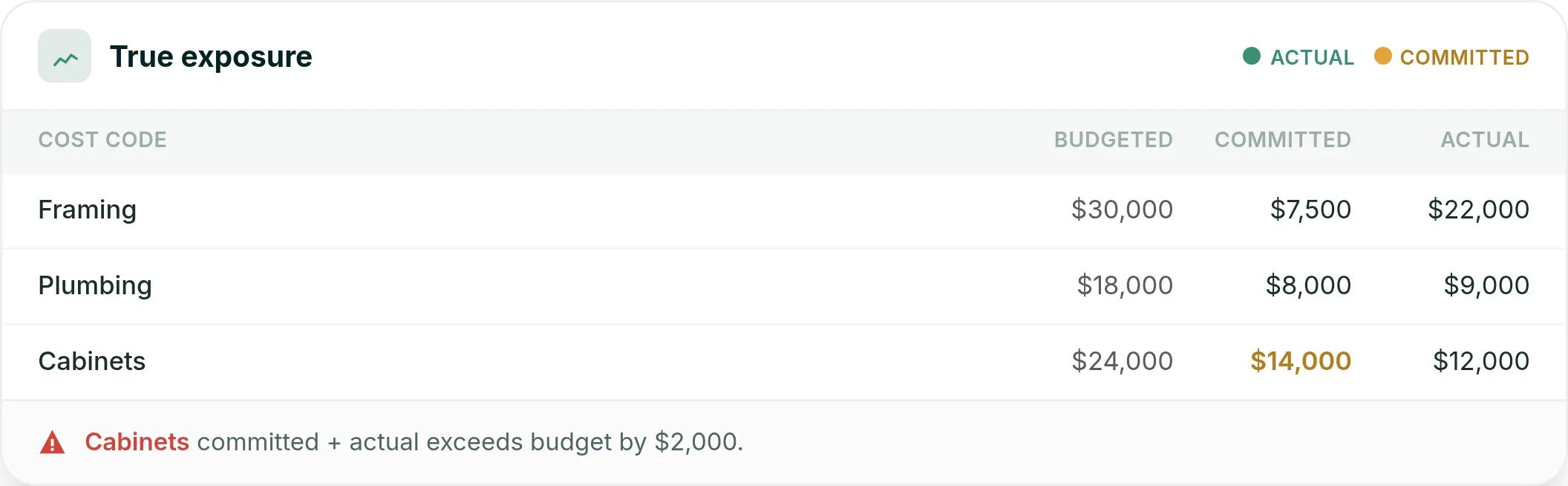
The builder raises the overage with the homeowner weeks before that bill, while there is still time to decide what to do. The homeowner has also asked for pantry shelves on the upper cabinet run, so the builder flags that line and sends the $1,250.00 Add Pantry Shelves change order to their phone. Their kitchen tile approval sits beside it, signed and timestamped May 28 at 2:14 PM.
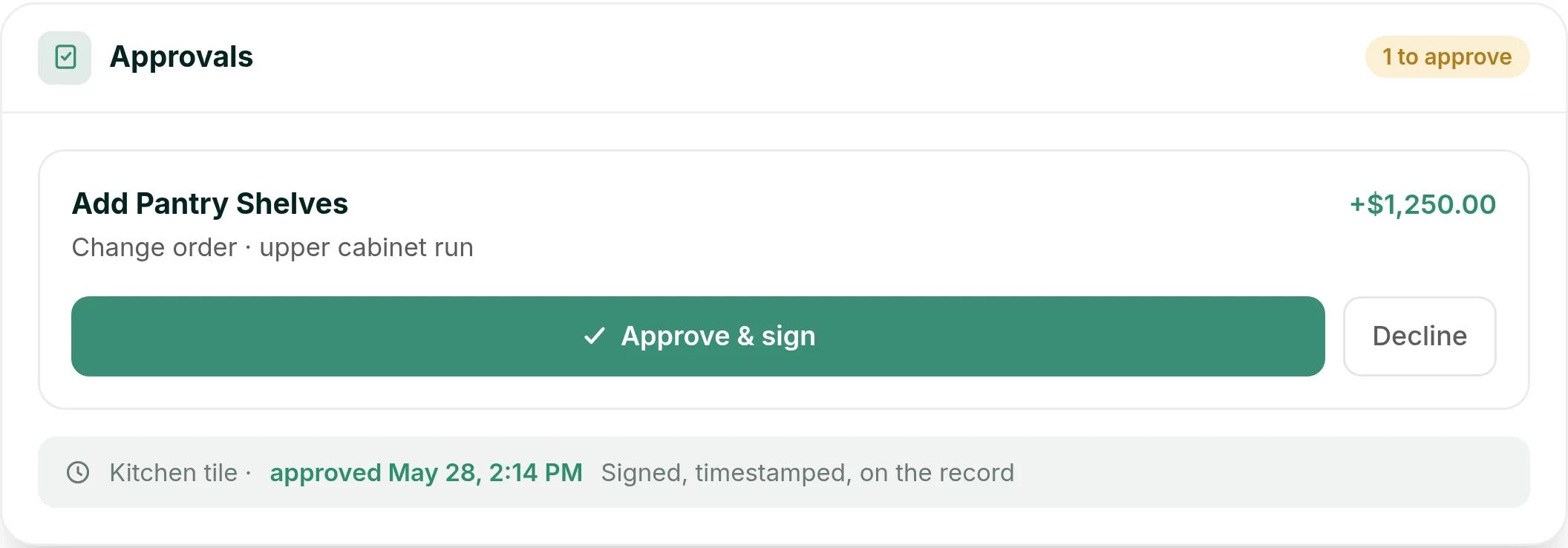
When the homeowner approves, the change flows into the budget, and the next invoice goes out from that budget with the change already in it. The conversation is about a number both sides could already see. If your cost-plus jobs still settle overruns from memory, book a Ressio demo and see committed costs, change orders and invoices tied to one budget before the bill arrives.
What a Builder Needs to Run Cost-Plus Well
Cost-plus transfers cost risk to the homeowner, and in exchange it obliges the builder to be transparent. That obligation is operational, not a matter of good intentions.
Costs need to be captured against the job as they occur rather than reconstructed at month end. Every reimbursable cost needs to be attributable to a line the homeowner can recognize. Change orders need to be written, priced and approved before the work happens.
And the current position against budget, and against the cap where one exists, has to be visible to both parties without either one having to ask.
Builders who run cost-plus successfully are not the ones with the lowest fee. They are the ones whose homeowners never have to wonder what a number means.
In Ressio, our invoicing supports percentage-complete billing for cost-plus work and builds each invoice from the same budget. The homeowner reviews it in their client portal alongside their payment history.
A Practical Starting Point
If you are moving to cost-plus, or tightening an arrangement you already use, three things settle most of the friction before it starts. Name the fee structure and its basis explicitly, including which items the fee is calculated on.
List the five contested cost categories by name and state which side they fall on. And agree how often the homeowner sees the cost position, then hold to it, because the reporting rhythm is what turns a cost-plus contract from a leap of faith into an ordinary working relationship.
We keep costs, change orders and the budget on one record for each job, which is what a cost-plus arrangement depends on.
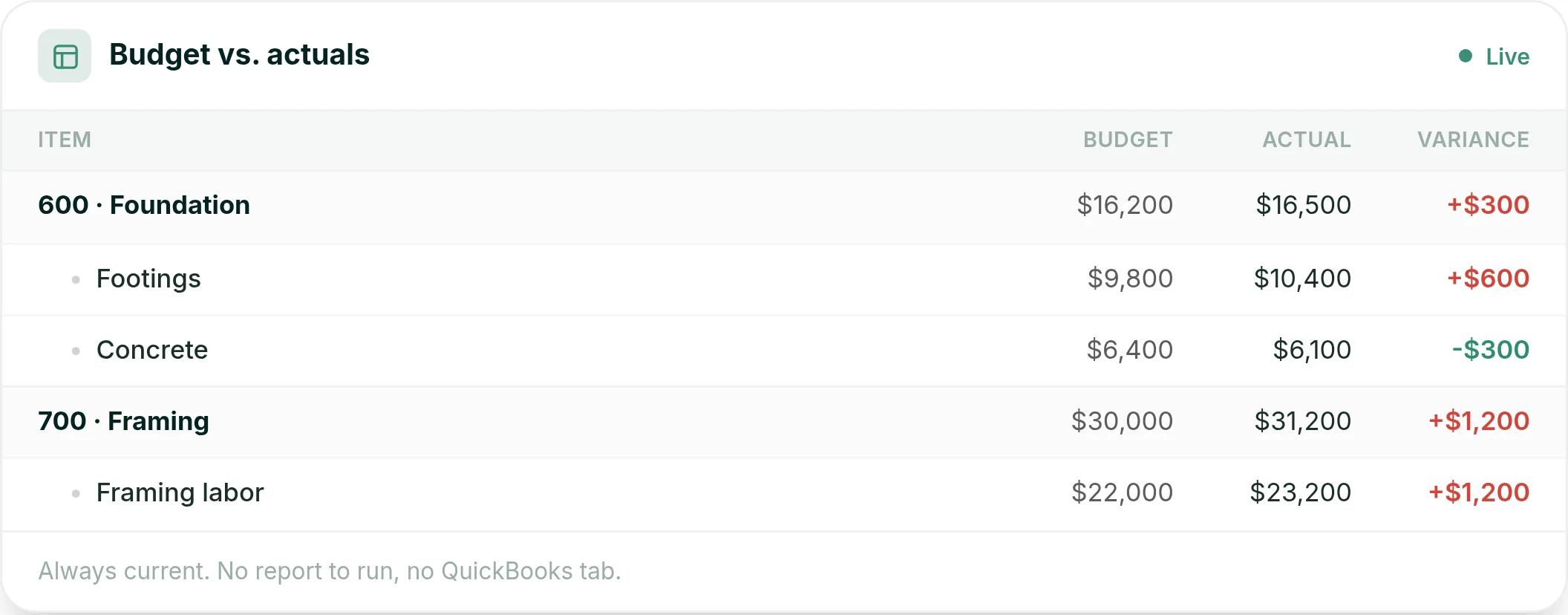
A cost-plus job runs on being able to show the homeowner where every dollar went while the job is still running. In a demo we will show you bills, time entries and expenses posting against each budget line as they arrive, with the variance on every line current, so the answer to "what is this charge?" is one click into the cost line. Book a Ressio demo and walk through it on one of your own jobs.
Frequently Asked Questions
What is a cost-plus contract in construction?
A cost-plus contract is an agreement where the homeowner pays the actual cost of the work plus an agreed fee for the builder. Costs cover labor, materials, equipment and subcontractors, and the builder's compensation is stated separately rather than buried inside a lump sum. It is the standard structure for custom homes and major renovations, because those are the projects where the final scope cannot be known on the day the contract is signed.
What is a typical cost-plus percentage?
Percentage fees commonly fall between ten and twenty percent of project cost, varying with market, project size and how much the builder is managing. The percentage is only half the question though: what the percentage is calculated on matters just as much, and a contract should state explicitly which cost categories the fee applies to.
What is the difference between cost-plus and fixed-price?
In a fixed-price contract the builder absorbs the gap between estimate and actual cost, so unknowns have to be priced defensively in advance and the homeowner pays for a contingency whether or not it is used. In cost-plus the real cost passes through and the homeowner takes on that variability instead. Fixed-price suits fully specified work; cost-plus suits work where the scope will evolve.
What costs are reimbursable under a cost-plus contract?
Usually materials, subcontractor invoices, direct site labor, equipment rental, permits, site utilities, disposal and project-specific insurance. Office rent, administrative staff, general insurance and marketing are normally covered by the fee. Five categories are contested and should be named in the contract: the site superintendent's wages, small tools, project manager time, warranty work, and rework caused by an error.
What is a guaranteed maximum price?
A cost-plus contract with a guaranteed maximum price passes costs through as normal but caps the total. Below the cap the homeowner pays actual cost plus fee; above it the builder absorbs the overage. It gives the homeowner a ceiling without forcing the builder to price every unknown defensively, and it demands rigorous cost tracking, because a cap only means something if both parties can see how close the project is to it.