
Construction invoice template
A construction invoice template is a structure for billing work that has been completed, in a form the person approving it can verify without calling you. Most late payments in construction are not refusals. They are invoices that could not be approved as written.

Ressio Staff
October 10, 2026
A construction invoice is not a general business invoice with a hard hat on it. It bills a percentage of an agreed schedule of values, it accounts for everything billed before it, and it withholds a portion that will not be released until the job is finished. Those three things change the shape of the document.
Here is that shape. The columns matter more than the styling.
| Scope item | Scheduled value | % complete | Completed to date | Previously billed | This period | Retainage 10% | Due this period |
|---|---|---|---|---|---|---|---|
| General conditions | $18,000 | 60% | $10,800 | $7,200 | $3,600 | $360 | $3,240 |
| Foundation | $42,000 | 100% | $42,000 | $42,000 | $0 | $0 | $0 |
| Framing | $65,000 | 85% | $55,250 | $39,000 | $16,250 | $1,625 | $14,625 |
| Roofing | $28,000 | 40% | $11,200 | $0 | $11,200 | $1,120 | $10,080 |
| Mechanical rough-in | $31,000 | 25% | $7,750 | $0 | $7,750 | $775 | $6,975 |
| Stored materials | $4,500 | $0 | $4,500 | $450 | $4,050 | ||
| Totals | $184,000 | $131,500 | $88,200 | $43,300 | $4,330 | $38,970 |
Above that table the invoice needs your details and the client's, an invoice number, the issue date, the payment due date, the contract or job it relates to, and the billing period covered. Below it, the amount now due in words and figures, accepted payment methods, and your terms.
The schedule of values is what makes progress billing possible
The scheduled value column is not invented at invoice time. It is agreed at the start of the job: the contract sum broken into line items that both parties accept. Every invoice then bills a percentage of those agreed figures.
This is why disputes on well-run jobs are about percentages rather than prices. The price was settled once. What remains is whether framing is 85 percent complete, which is a question somebody can walk the site and answer.
How the schedule of values gets agreed in the first place depends on the contract type; see how a GMP contract sets the schedule of values.
If your invoices start with a blank line-item list each month, you do not have progress billing. You have a series of unrelated bills, and each one reopens the pricing conversation.
Previously billed is the column that prevents the worst argument
Completed to date minus previously billed equals this period. That single subtraction is what stops double billing, and it is the column most often missing from generic invoice templates. The AIA G703 continuation sheet, often called the schedule of values, tracks the same figures: work completed to date, prior payments and the amount now requested.
It also gives the client a running reconciliation. They can see that $131,500 of $184,000 has been earned, $88,200 was paid before, and $43,300 is what this invoice covers. A client who can follow the arithmetic pays faster than one who has to trust it.
Retainage, and the arithmetic that surprises people
Retainage is a percentage held back from each payment, released after completion. Ten percent is common on residential work, sometimes reducing to five at substantial completion.
The part that catches people out is that retainage accumulates against your margin, not against the job. On the invoice above, $4,330 is withheld this period. Across a job of $184,000 at ten percent, roughly $18,400 sits unreleased until the end, and on a build with a fifteen percent margin, that held sum is most of the profit.
The job can be complete, the work accepted, and the profit still outstanding.
Two things follow. Withhold from your subcontractors on the same terms you are withheld from, or you are financing the retainage yourself. And put the release condition in writing: what event releases it, and how many days after.
Terms change when you get paid, so write them plainly
Net 30 from the invoice date is not the same as net 30 from approval, and on a job with a monthly approval cycle the difference can be three weeks. State which one applies.
Say what happens when payment is late, and be specific: a stated monthly rate on overdue amounts is enforceable in a way that a general statement about interest is not. Name accepted payment methods. If you accept cards and pass the processing fee on, say so on the invoice rather than adding it afterwards.
Most late payment in construction is not refusal. It is an invoice that arrived without enough information for somebody to approve it, sitting on a desk waiting for a question to be answered.
Where a construction invoice template stops holding up
An invoice template works while the numbers live in one place. The strain appears when the schedule of values sits in the contract, percentages complete live in someone's head or a site photo, previously-billed totals live in last month's invoice, and change orders live in email. Every invoice becomes a reconciliation exercise, and the errors that result are almost always in the client's favor, because those are the ones that get spotted.
In Ressio, we make the schedule of values the project budget itself, we attach change orders to the line they move, and we keep every invoice already sent on the record. This period is calculated from those three rather than remembered across them.
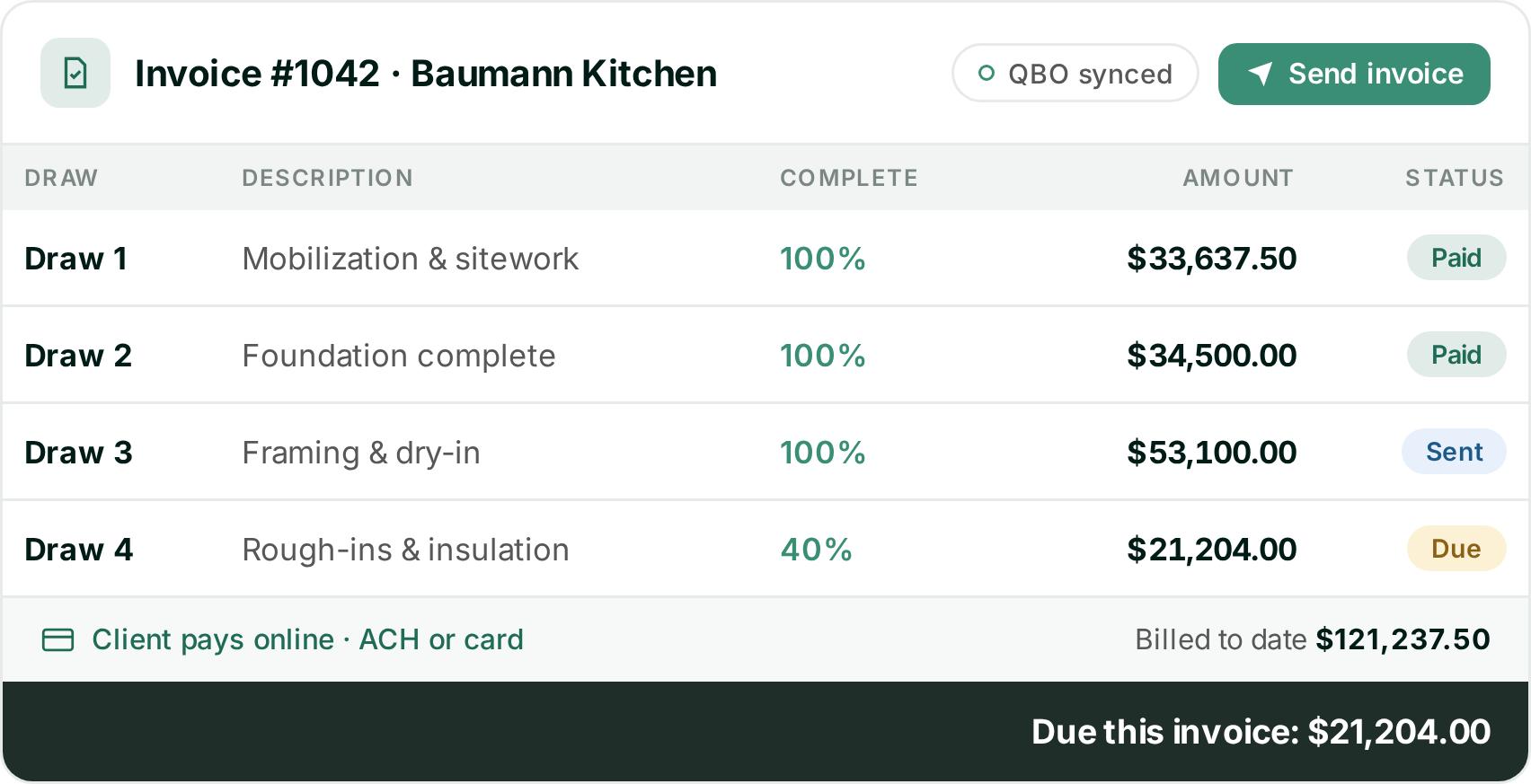
Here is one invoice doing it. The Baumann kitchen is billed in four draws. Mobilization and foundation are complete and paid.
Framing and dry-in went out last month at 100 percent, $53,100, and is still marked sent. This month only the rough-ins moved, to 40 percent, so that is the only line with an amount: $21,204 for this period.
Billed to date reads $121,237.50, which is the three earlier draws and nothing else, because previously billed is a sum we already hold rather than a number somebody carries forward from last month's PDF. If the contract holds retainage, it comes off the same line at the contract rate.
On a single job that is a convenience. Across six, it is the difference between billing on time and billing when you get to it. To see invoices generated from the project budget, book a Ressio demo.
Frequently Asked Questions
What should a construction invoice include?
Both parties' details, an invoice number, issue and due dates, the job or contract reference, the billing period, and a line-item table showing scheduled value, percent complete, completed to date, previously billed, the amount for this period, retainage withheld and the net due.
How does progress billing work in construction?
The contract sum is broken into a schedule of values at the start of the job. Each invoice bills the percentage of each line item completed to date, subtracts what was billed previously, and withholds retainage on the balance.
What is retainage and how much is normal?
Retainage is a percentage withheld from each payment until the job is complete. Ten percent is common on residential work, sometimes reduced at substantial completion. Withhold from subcontractors on the same terms, or you are carrying the cost yourself.
Can I bill for materials that have been delivered but not installed?
Usually yes, as stored materials, if the contract allows it. They are shown as a separate line with a value but no percent complete, and are typically subject to the same retainage as installed work.
Why do construction invoices get paid late?
More often than not because the invoice does not contain enough for the person approving it to approve it. An invoice that shows completed to date, previously billed and this period, against an agreed schedule of values, answers the questions before they are asked.